
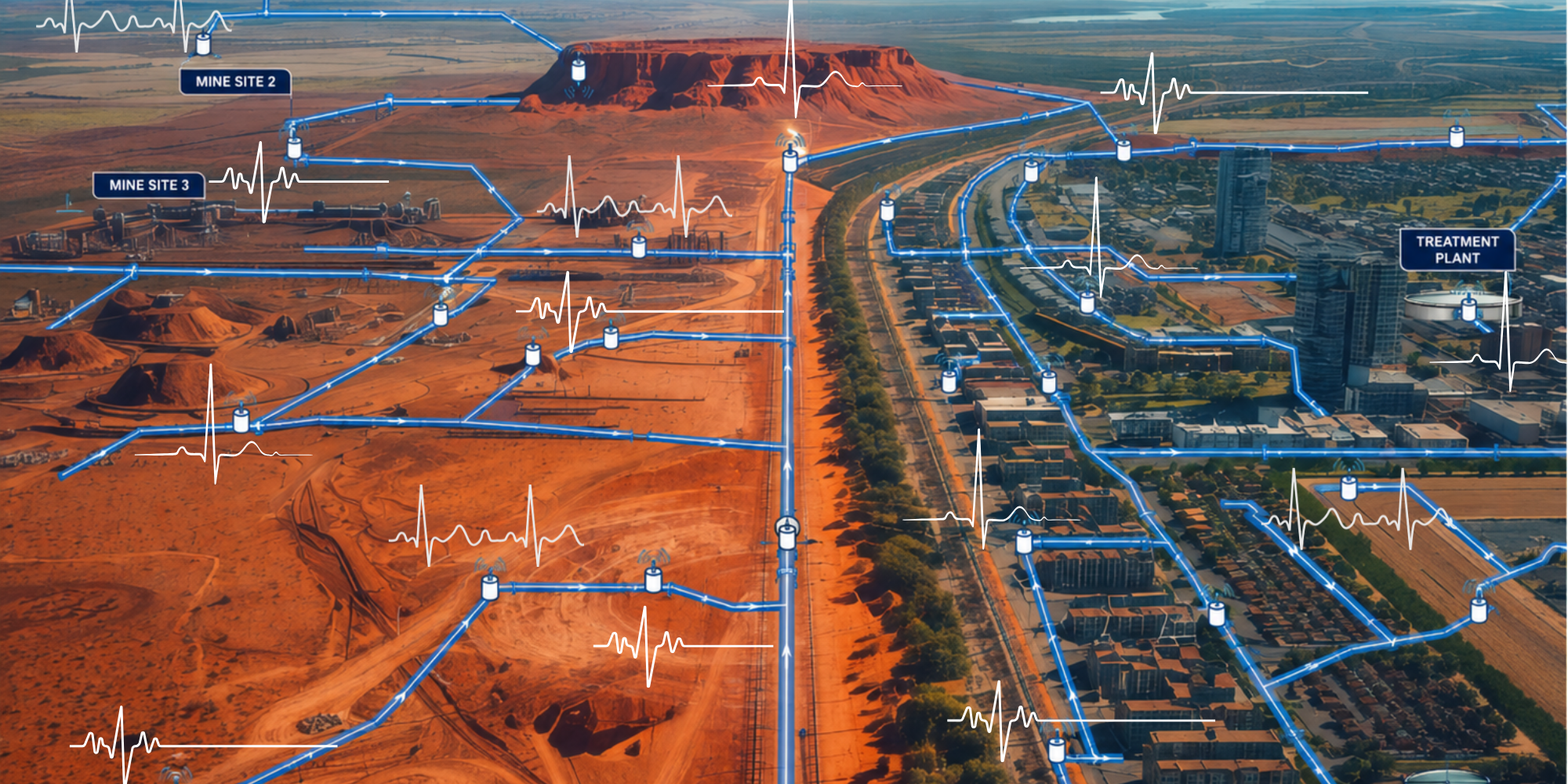
Whether its the Bourke St Mall or the back of Bourke pipe failure is rarely instantaneous. A crack initiates, propagates, and generates detectable acoustic energy long before the pipe gives way. That interval – the leak-before-break window – is where the real opportunity lies for water utilities and mining companies managing high-consequence infrastructure.
Recent Australian studies indicate that in roughly 60% of burst events, a leak was already present before failure. That single statistic reframes how the industry should think about network integrity. Bursts are not random, unpredictable events; in most cases, they are the final stage of a process that acoustic monitoring can detect early enough to act on.
Smart Water Network operators applying this principle have reduced mains bursts by more than 50% by identifying and repairing leaks before they escalate into failures.
That interval – the leak-before-break window – is where the real opportunity lies for water utilities and mining companies managing high-consequence infrastructure.
From Reactive to Predictive
Traditional acoustic correlation relies on pairing two sensors and inferring a leak’s location from timing differences. It struggles to distinguish between a cracked pipe, a failing joint, a customer connection leak, and ambient environmental noise — and it typically only detects leaks once they are already substantial.
That’s a problem when the asset in question is a critical water main beneath a CBD intersection, or a slurry or tailings pipeline through remote mining terrain where failure means environmental damage, production downtime, and reputational fallout.
Adelitics’ leak noise analysis platform is built around the leak-before-burst philosophy. Each sensor operates as a standalone unit – no reliance on correlating pairs – using AI/ML to classify the source of acoustic signals rather than simply flagging noise. That distinction matters: it means the platform can pick up small, early-stage crack signatures well before conventional acoustic sensors would register anything, and can tell the difference between a genuine pipe defect and background interference.
The practical benefits compound quickly. Fewer false alarms build genuine confidence in the system among operations teams. Standalone sensors mean fleets scale without the density typically required for correlation-based coverage, so networks can be monitored more broadly with fewer devices. Higher-accuracy detection turns alerts into actionable work orders for leakage teams, rather than noise for them to chase.
Whether the asset sits in the outback, on a remote mine site, or under a busy metropolitan footpath, the same platform delivers consistent, continuous coverage.
Why It Matters for Non-Revenue Water
For utilities, this is fundamentally a Non-Revenue Water (NRW) problem. Every undetected leak is lost water, lost revenue, and rising risk. Extending sensor coverage across more of the network, while improving the accuracy of what each sensor reports, is the most direct lever available for reducing NRW – and it only works if the underlying detection technology can be trusted to tell a real leak from noise.
A Different Way to Consume the Technology
Adelitics delivers this capability as a service, not a capital project. Under the Data-as-a-Service model, clients receive continuous monitoring, alarm verification, and reporting as standard. A fixed monthly fee per device covers hardware, communications, maintenance, and hosting – removing upfront capital risk and ongoing technology management from the client’s plate.
A variable fee applies only when a field investigation is actually required, aligning cost directly with outcomes rather than sensor count.
For infrastructure where failure carries a high consequence – critical mains, mining pipelines, assets in sensitive or hard-to-access locations – this model turns leak detection from a periodic capital investment into an operational discipline. The earlier a crack is heard, the more options remain: scheduled repair instead of emergency response, contained cost instead of catastrophic failure, and a network that stays ahead of its own risk profile.
The leak-before-burst window exists in every network. The only question is whether anyone is listening for it.
If you’re struggling with unplanned bursts, rising NRW, false alarms from correlation-based sensors, or the capital burden of a large monitoring fleet, then permanent acoustic monitoring will provide you with earlier warning, fewer sensors, and greater confidence in every alarm you act on.
Talk to one of our technical experts about a DaaS trial on your network – from the outback to the CBD.