
Are Traditional Flowmeters Holding Water Networks Back?
Picture a water network the way its engineers do – not as a map of pipes, but as a map of knowledge. Every monitoring point is a window into the network’s behaviour: pressure trends, flow anomalies, early signs of stress. The more windows you have, the clearer the picture. The problem is that for most utilities and councils, the location of those windows has never been determined by where monitoring is most needed. It has been determined by where the power is.
That single constraint – the availability of a mains power supply – has quietly shaped water network management for decades. And the cost of it, while rarely appearing in any budget line, is enormous.
A Network Built Around Infrastructure, Not Intelligence
Traditional flowmeters are reliable, accurate, and well-understood. They are also, in one critical respect, inflexible: they need power to run. In practice, this means monitoring infrastructure tends to cluster around substations, pump stations, and treatment facilities – places where electricity is readily available. The further a section of the network sits from that infrastructure, the less likely it is to be properly observed.
For urban networks, this can mean significant blind spots in residential distribution zones, trunk main extremities, and service reservoirs on higher ground. For regional utilities and rural councils, the problem is far more acute. Remote townships, agricultural supply lines, and isolated district metering areas (DMAs) may go entirely unmonitored – not because the data isn’t valuable, but because the cost and complexity of getting power to those locations makes traditional metering impractical.
The result is a network that is managed as though it is fully understood when, in reality, large portions of it are operating on assumption rather than evidence.
Remote townships, agricultural supply lines, and isolated district metering areas (DMAs) may go entirely unmonitored – not because the data isn’t valuable, but because the cost and complexity of getting power to those locations makes traditional metering impractical.
The Compound Cost of Incomplete Visibility
The hidden cost of power dependency isn’t a single line item – it accumulates across every decision made without reliable data. Leakage that goes undetected in unmonitored zones inflates non-revenue water figures and drains operational budgets. Pressure anomalies that aren’t caught early escalate into pipe failures. Water quality variations that aren’t tracked reach customers before anyone realises there is a problem.
For regional and rural utilities, the stakes are even higher. Serving communities across large geographic areas with limited field crews means that by the time a problem is detected manually, significant damage has often already occurred. A leaking main in a remote area might run for days before it is noticed. A pressure event in an outlying DMA might only come to light when a customer reports low flow at the tap.
These are not edge cases. They are the everyday reality of managing water networks that were designed with physical infrastructure in mind, not data coverage.
Battery-Powered Devices: A Partial Solution with Its Own Problems
The industry’s initial answer to the power problem was the battery-powered meter – a device that could theoretically be deployed anywhere. In practice, however, battery-powered monitoring introduces a different set of constraints. Transmission frequency is often throttled to preserve battery life, meaning data arrives in intervals rather than in real time. Batteries need to be replaced on a regular cycle, which generates ongoing maintenance costs and requires field crews to visit remote sites. And in locations where ambient temperatures fluctuate significantly, battery performance can be unpredictable.
The result is a compromise: broader coverage, but at the cost of the data quality and reliability that makes monitoring genuinely useful. For utilities trying to detect night-line flow anomalies, track pressure transients, or build accurate hydraulic models, intermittent data is not much better than no data at all.
Self-Powered Technology: Rethinking What’s Possible
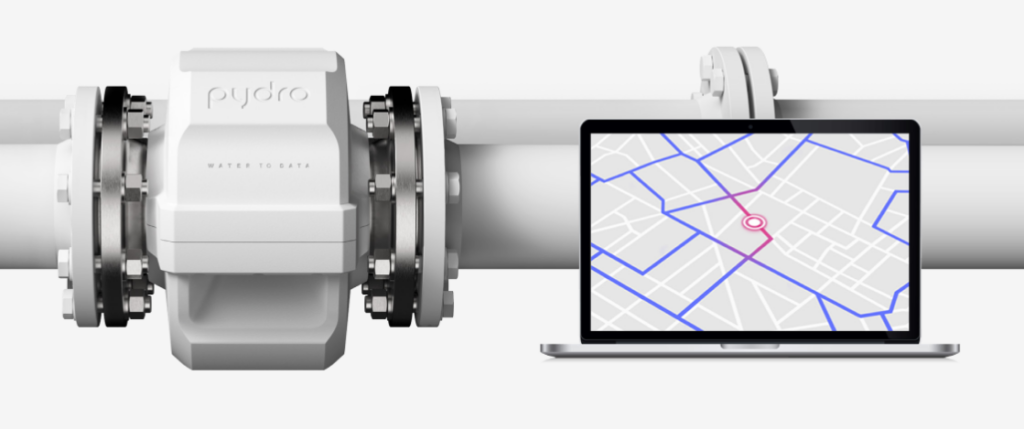
The more elegant solution is to remove the power dependency altogether – and the water network itself provides the means to do it. Hydro-powered metering technology, such as that used in the Pydro PT1, harvests energy directly from the kinetic flow of water moving through the pipe. That energy powers the device continuously, keeps a backup battery topped up, and supports real-time data transmission via LTE – with no external power supply required.
For utilities and councils, this fundamentally changes the monitoring conversation. Deployment is no longer constrained by proximity to power infrastructure. A DMA boundary in a remote township, a trunk main running through agricultural land, a service zone at the edge of a regional network – all of these become viable monitoring locations. The decision about where to place a meter can finally be driven by where the data is most needed, not where the nearest power outlet happens to be.
Critically, self-powered does not mean reduced capability. The PT1 measures flow rate, flow velocity, volume (forward, reverse, and net), pressure, and temperature at accuracy levels consistent with mains-powered devices – delivering the quality of data needed to support leakage reduction programs, hydraulic modelling, and regulatory compliance, from any point in the network.
Closing the Visibility Gap
The case for network-wide monitoring has never been stronger. Regulatory pressure on non-revenue water is increasing. Climate variability is making demand patterns less predictable. Ageing infrastructure is raising the stakes on early fault detection. And customers – whether urban households or rural communities — have less tolerance than ever for supply interruptions and water quality issues.
For too long, the answer to these pressures has been limited by the question of where power could realistically be supplied. Self-powered metering technology means that question no longer needs to be asked. The network itself provides the power. All that remains is the decision to use it.
If you have any questions about the Pydro PT1 please get in touch with our technical team.